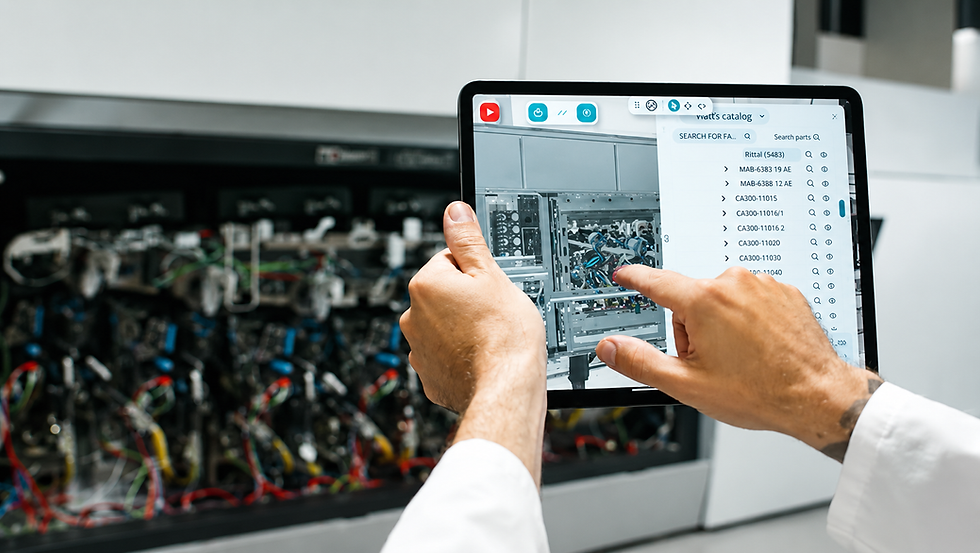
What Is AR Remote Assistance? How Augmented Reality Is Transforming Remote Support

AR remote assistance is technology that lets an off-site expert see a field worker's live view and guide them with augmented reality annotations (arrows, circles, 3D models, and step-by-step instructions anchored to real equipment). Instead of describing a fix over the phone, the expert draws it directly onto the technician's world, cutting repair times and errors dramatically.
That's the short answer. The longer answer is that AR remote assistance is quickly becoming the difference between a machine that's down for hours and one that's down for minutes. In this guide, we'll break down how it works, what the research actually shows, and how to choose the right remote visual assistance platform for your team.

How does AR remote assistance work?
AR remote assistance connects two people through one shared view:
The field worker (technician, operator, inspector) points a device (smartphone, tablet, or AR smart glasses) at the equipment. The device streams live video of what they see.
The remote expert watches that stream from anywhere in the world and adds AR annotations: directional arrows, circles around fault points, hand-drawn markings, or even full 3D models of the assembly.
The annotations stay anchored to the physical equipment. Thanks to SLAM (Simultaneous Localization and Mapping) and modern spatial tracking, a circle drawn around a bolt stays on that bolt even as the worker moves around, no "freeze screen" workarounds required.
Both sides talk in real time over integrated voice and video, so guidance flows naturally: "Loosen this connector", with the arrow pointing at exactly the right one.
Modern systems go further than annotation. A 2025 study published at the IEEE AIITA conference describes remote maintenance systems where the expert can manipulate a 3D model/digital twin of the equipment on the technician's screen, playing disassembly and assembly animations step by step so the worker sees the procedure before performing it, on hardware they already own.
Why are companies replacing phone and video support with AR remote support?
Because plain voice and video leave too much room for error. Research comparing guidance methods for a complex gearbox assembly task found:
Guidance method | Average completion time | Errors |
Paper assembly drawings | 876 seconds | 4 |
Standard video call | 387 seconds | 0 |
AR remote assistance | 204 seconds | 0 |

That's a 76.7% improvement over drawings and 47.3% over video calls (Yu, Sun & Chen, IEEE AIITA 2025). The researchers noted why: traditional voice guidance relies on directional language ("the one on the left... no, your other left"), which breaks down completely on complex, multi-part equipment. AR annotation removes the ambiguity, the expert points at the exact part, position, and step.
The same pattern holds in quality inspection. A 2026 study in the International Journal of Human–Computer Interaction tested cross-reality remote inspection with virtual replicas and found error rates fell from 20.19% with no assistance to just 2.88% with XR assistance (an 86% reduction) while 88.5% of remote experts preferred the XR system over screen-based alternatives (Wu et al., 2026).
What are the measurable benefits of augmented reality remote assistance?
Across recent industrial studies, the numbers are remarkably consistent:
Faster task execution.
An adaptive AR assistance architecture tested on industrial maintenance and assembly tasks reduced task execution time by 16.7% compared with conventional methods (Morales Méndez & del Cerro Velázquez, Big Data and Cognitive Computing, 2025).
Fewer errors.
The same study measured a 40% reduction in error rates, while earlier assembly research found AR instructions cut task errors by 33.2% versus traditional manuals — and reduced errors like wrong tool selection or incorrect assembly order by up to 72.7%.
Lower cognitive load.
Perceived mental workload (measured on the NASA-TLX scale) dropped 17.2% when operators received AR guidance in their field of view instead of consulting external documentation.
Safer operations.
Occupational safety incidents and near misses fell 41.7% in AR-assisted conditions, workers keep their hands free and their eyes on the equipment, not on a manual.
Less downtime, less travel.
When an expert can "be there" in seconds instead of days, repair cycles shrink and travel costs largely disappear. One expert can support multiple sites in a single day. Heavy-industry deployments over private 5G networks report transmission speeds up to 4× faster than 4G, making real-time remote collaboration viable even on continuous 24-hour production lines (He, Chang & Wu, IEEE ICCE-Taiwan 2025).
Knowledge transfer built in.
Every guided session doubles as on-the-job training. Research on AR-based training of assembly line workers shows the economics improve with scale, AR training becomes more cost-effective than traditional instructor-led training once you're onboarding multiple employees, and it standardizes training quality across every operator (Malega et al., Applied Sciences, 2026).

What is AR remote assistance used for?
The most common use cases across manufacturing, energy, medtech, and heavy industry:
Remote maintenance and troubleshooting — an expert diagnoses and guides repairs on complex equipment without traveling to site. AR remote maintenance is the single biggest driver of adoption.
Guided disassembly and assembly — step-by-step 3D animations overlaid on real machinery walk technicians through procedures they've never performed.
Remote quality inspection — experts inspect products through the local worker's camera, with AI-assisted defect detection highlighting problem areas on a shared virtual replica.
Field service support — frontline service teams escalate to a remote expert mid-job instead of scheduling a second visit ("see what I see" support).
Remote audits and factory acceptance tests — inspectors conduct line walks and equipment sign-offs from anywhere, a practice that became standard during COVID-19 and never went away.
Training and onboarding — new operators learn on real equipment with an expert (or pre-built AR work instructions) guiding every step.

What should you look for in remote assistance software?
Based on the pain points documented in recent research, evaluate AR remote assistance platforms on these criteria:
No "freeze screen" annotation. Older systems froze the video to place annotations, interrupting workflow. Modern real-time annotation with local plane fitting keeps guidance flowing while the camera moves.
Works on hardware you already own. The best systems run on standard smartphones and tablets, with optional support for AR headsets (no mandatory hardware purchase). Low deployment requirements were highlighted as a decisive adoption factor in the 2025 AIITA research.
3D model/digital twin support. Annotation alone helps; the ability to load your CAD models and play interactive disassembly/assembly sequences on the live view is where guidance efficiency jumps.
Session recording and knowledge capture. Every expert session should become reusable training material, not vanish when the call ends.
Low latency. Annotation response times climb steeply as network latency grows (from ~118 ms at zero latency to ~332 ms at 200 ms network delay in controlled tests). Look for platforms engineered for real-time performance.
Enterprise security. Industrial video streams contain sensitive IP. Look for deployment options that keep data within your control.

Migrating from Dynamics 365 Guides? Here's what to know
If your organization built AR work instructions or remote assistance workflows on Microsoft Dynamics 365 Guides, note that Dynamics 365 Guides reaches end of support on December 31, 2026. Teams currently relying on it for HoloLens-based guidance and remote assistance should plan their migration now, ideally to a platform that is device-independent, so you're not locked to a single headset's lifecycle again.
Reading the research is one thing. Watching your own expert circle a fault point on a technician's screen 3,000 km away is another.
frontline.io Remote Assist gives your team AR-powered remote assistance that runs on the devices you already have (live video, real-time AR annotations, 3D model/digital twin guidance, and session capture for training) built for industrial equipment manufacturers and their service teams.
👉 Start your free 14-day trial of Frontline.io Remote Assist and run your first guided session today. No specialized hardware required.
Frequently asked questions
What is the difference between remote assistance and AR remote assistance?
Traditional remote assistance is a phone or video call: the expert describes what to do. AR remote assistance adds spatially anchored visual guidance — annotations, arrows, and 3D models pinned to the actual equipment in the worker's view — removing the ambiguity of verbal directions. Studies show this cuts guidance time nearly in half compared with plain video calls.
Do I need AR glasses or a headset for AR remote assistance?
No. Modern AR remote assistance platforms run on standard smartphones and tablets (iOS and Android), with AR headsets as an optional upgrade for hands-free work. Markerless SLAM tracking means annotations stick to equipment using just the device's camera.
How much does AR remote assistance reduce errors?
Peer-reviewed studies from 2025–2026 report error reductions ranging from 40% in maintenance and assembly tasks to 86% in remote quality inspection (from a 20.19% error rate with no assistance down to 2.88% with XR assistance).
Is AR remote assistance worth it for small teams?
Yes, the ROI comes from avoided travel, reduced downtime, and faster first-time fixes rather than headcount. Cost analyses show AR-based guidance and training become more economical than traditional methods once multiple employees or sites are involved, and a free trial lets you validate the fit before committing.
How does AR remote assistance improve worker safety?
Guidance appears directly in the worker's field of view, so they keep both hands on the task and never look away to consult a manual. Research measured a 41.7% reduction in safety incidents and near misses with AR assistance compared with conventional documentation.
What industries use AR remote support the most?
Automotive and discrete manufacturing, industrial machinery, energy and utilities, steel and heavy industry, medical device manufacturing, and field service organizations — anywhere complex equipment, distributed sites, and scarce expert knowledge intersect.
References:
He, Sirius, Chia-Wei Chang, and I-An Wu. "Remote Expert Augmented Reality Collaboration System." In 2025 IEEE International Conference on Consumer Electronics – Taiwan (ICCE-Taiwan), 241–42. IEEE, 2025. https://doi.org/10.1109/ICCE-Taiwan66881.2025.11208154.
Malega, Peter, Juraj Kováč, Matúš Leščinský, and Róbert Sabol. "Augmented Reality as a Tool for Training Assembly Line Workers." Applied Sciences 16, no. 5 (2026): 2175. https://doi.org/10.3390/app16052175.
Morales Méndez, Ginés, and Francisco del Cerro Velázquez. "Adaptive Augmented Reality Architecture for Optimising Assistance and Safety in Industry 4.0." Big Data and Cognitive Computing 9, no. 5 (2025): 133. https://doi.org/10.3390/bdcc9050133.
Wu, Like, Shihui Xu, Wenjie Liao, and Shigeru Fujimura. "Augmented Remote Assistance for Quality Inspection: A Cross-Reality Collaborative System With Virtual Replicas." International Journal of Human–Computer Interaction 42, no. 5 (2026): 3615–51. https://doi.org/10.1080/10447318.2025.2534059.
Yu, Youxin, Mingming Sun, and Chengjun Chen. "Design of an Augmented Reality-Based Remote Maintenance and Disassembly System." In 2025 5th International Conference on Artificial Intelligence and Industrial Technology Applications (AIITA), 1573–78. IEEE, 2025. https://doi.org/10.1109/AIITA65135.2025.11048139.