Digital Twin in Manufacturing: Definition, Benefits & Use Cases (2026 Guide)

A digital twin in manufacturing is a virtual replica of a physical machine, product, production line, or factory that uses real-time data to monitor performance, predict issues, optimize processes, and support better decision-making. Unlike a static 3D model, a digital twin stays continuously connected to its physical counterpart through sensors, software, and automated bidirectional data exchange (Villegas et al., 2025, p. 1).

What Is a Digital Twin in Manufacturing?
The concept originates from NASA's aerospace work, where a digital twin was defined as an integrated, multi-physics, probabilistic simulation of a vehicle that mirrors the life of its physical counterpart using the best available physical models and sensor updates (Fuhrländer-Völker et al., 2025, p. 960). In manufacturing, the definition has evolved considerably.
ISO 23247 specifies a manufacturing digital twin as a "digital representation of an observable manufacturing element with synchronisation between the element and its digital representation," where the element must have a physical presence or operation (Fuhrländer-Völker et al., 2025, p. 960).
A broader theory-driven definition frames it as a Complex Adaptive System - one where the mutual dependency between the digital system (data, models, and services) and the physical system (products, assets, production lines, supply chains) enables dynamic adaptation in complexity and functionality to meet evolving application requirements (Villegas et al., 2025, p. 14).
One distinction matters above all else: a digital twin is not a 3D model or a dashboard. The defining characteristic is automated, bidirectional data flow - what separates it from two related but less capable concepts:
Concept | Data Connection | Direction |
Digital Model | Manual data entry only | None (disconnected) |
Digital Shadow | Automated data from physical to digital | Unidirectional |
Digital Twin | Automated, real-time data in both directions | Bidirectional |
What Are the Benefits of Digital Twins in Manufacturing?
Digital twin technology delivers measurable value across multiple operational areas:
Reduced downtime - Continuous condition monitoring enables failures to be predicted and addressed before they occur, keeping production lines running.
Predictive maintenance - Machine behavior data feeds predictive models that flag components approaching failure thresholds, replacing reactive repair cycles.
Improved quality control - Real-time production monitoring detects defects and process deviations as they happen, reducing scrap and rework.
Energy optimization - Digital twins model energy consumption patterns and recommend or autonomously execute efficiency adjustments. In one validated industrial case, a digital twin for demand response on a manufacturing machine achieved a 78.45% reduction in energy costs during field testing (Fuhrländer-Völker et al., 2025, p. 968).
Faster product development - Virtual prototyping and simulation reduce the need for physical prototypes, shortening time-to-market and development costs.
Better supply chain visibility - Digital representations of supply networks enhance traceability, inventory management, and disruption resilience.
Workforce training - Virtual replicas of equipment and processes allow safe, repeatable training without interrupting production.

Digital Twin vs. Digital Shadow vs. Simulation: What Is the Difference?
These three terms are often confused but represent meaningfully different capabilities:
A simulation is a one-time or on-demand model run. It is not connected to a real physical system and does not update automatically. It answers "what if" questions based on assumed inputs.
A digital shadow receives data automatically from the physical entity but cannot send commands back. It reflects the current state of the system but plays no active role in controlling it.
A digital twin does both. It receives real-time data from the physical system and can send instructions back to it - enabling closed-loop monitoring, optimization, and in advanced cases, autonomous control (Aurich et al., 2025, p. 2–3). This bidirectional connection is what makes digital twin technology in manufacturing genuinely transformative rather than simply descriptive.
What Are the Three Manufacturing Domains Where Digital Twins Apply?
Manufacturing digital twin applications are organized across three interconnected domains (Villegas et al., 2025, p. 5):
1. Product Domain - Covers the full product lifecycle from design through use, maintenance, and end-of-life. Digital twins here enable virtual prototyping, predictive asset maintenance, and continuous performance improvement based on real operational data.
2. Production Domain - Focuses on manufacturing processes and the systems that produce goods. Digital twins optimize production efficiency, ensure quality control, and manage logistics across the supply chain.
3. Service Domain - Encompasses after-sale service delivery, operational risk management, and workforce training. Digital twins support personalized service offerings, proactive risk mitigation, and virtual training environments.

What Are the Main Applications of Digital Twins in Manufacturing?
A systematic review of the manufacturing literature identifies nine primary digital twin applications across these three domains (Villegas et al., 2025, pp. 6–7):
Product Design Optimization - Virtual prototyping and iterative testing before physical production.
Product Maintenance - Predictive and proactive maintenance by monitoring product condition across the lifecycle.
Product Performance - Simulation of product behavior under varying operational conditions.
Production Optimization - Bottleneck identification, resource utilization, and shop-floor flexibility improvements.
Quality Control Optimization - Real-time defect detection and process compliance monitoring.
Supply Chain Management - End-to-end supply chain visibility, resilience, and inventory optimization.
Service Delivery Optimization - Personalized post-sale services and faster customer response times.
Risk Management - Continuous parameter monitoring to proactively identify and mitigate operational hazards.
Training and Education - Virtual simulation environments for safe workforce skill development.
Digital Twin in Manufacturing Examples by Industry
Industrial digital twin technology has been validated across a wide range of sectors:
Automotive - Production line digital twins monitor assembly processes in real time, detect quality deviations instantly, and feed data into predictive maintenance schedules for robotic equipment.
Aerospace - The original application domain. Digital twins of aircraft components track structural health across their operational lifetime, enabling condition-based maintenance rather than fixed-interval overhaul.
CNC Machine Tools - Digital twins of machine tool spindles use vibration sensor data and AI-trained neural networks to predict bearing loads and prevent overload failures in real time (Fuhrländer-Völker et al., 2025, p. 969).
Smart Factories - Factory-level digital twins model energy flows, material flows, and production scheduling simultaneously, enabling holistic optimization across the entire manufacturing system.
Pharmaceuticals - Process-level digital twins monitor critical quality attributes during production, enabling continuous verification and reducing batch failures.
Electronics - Digital twins of circuit board assembly lines detect micro-defects and correlate process parameters with yield outcomes.

What Are the Five Maturity Levels of a Manufacturing Digital Twin?
Not all digital twins are equal. A widely adopted taxonomy identifies five maturity levels (Villegas et al., 2025, pp. 7–9):
Maturity Level | Core Capability | Data Flow |
Model Digital Twin | Static virtual representation; manual data entry | Disconnected |
Connected Digital Twin | Real-time replica of current system state | Unidirectional (physical to digital) |
Predictive Digital Twin | Anticipates future behavior using ML and statistical models | Unidirectional + automated predictions |
Prescriptive Digital Twin | Delivers actionable recommendations; simulates trade-offs | Automated information flow |
Autonomous Digital Twin | Self-learning; makes and executes decisions independently | Bidirectional, closed-loop |
Most current industrial implementations sit at the Connected and Predictive levels. Prescriptive and Autonomous deployments represent the active research frontier. The autonomous level leverages self-learning, self-optimization, and self-adaptation to act on the physical environment without human intervention (Villegas et al., 2025, p. 9).
How Are Digital Twins Classified by Purpose, Level, and Model Type?
The Digital Twin Manufacturing Application Taxonomy (DT-MAT) classifies any manufacturing digital twin across three practical dimensions (Aurich et al., 2025, pp. 8–12):
Purpose of Application:
Monitoring & Control - Real-time supervision and automated feedback (present in 88.6% of studied implementations - the dominant use case).
Prediction - Forecasting future events such as tool wear, machine failure, or material demand (61.4%).
Analysis - Historical data analysis to diagnose root causes and identify improvements (23.6%).
Level of the Manufacturing System:
Machine Level - Individual machines and subsystems (43.6% of implementations — most common).
Factory Level - Entire manufacturing system including material, energy, and information flows (40.0%).
Process Level - Specific manufacturing operations affecting the workpiece directly (29.3%).
Model Type:
White-box - Physics-based mathematical models. Transparent but computationally demanding (56.4%).
Grey-box - Hybrid models combining physical knowledge with data-driven AI. Growing rapidly since 2020 (27.9%).
Black-box - Pure AI and machine learning, no physical model required (15.7%).
How Do You Build a Digital Twin in Manufacturing?
A structured six-step methodology guides practitioners from concept to deployment (Fuhrländer-Völker et al., 2025, pp. 963–965):
Define the objective - Identify precisely what problem the digital twin must solve and which physical components need virtual representation.
Derive requirements - Document essential functionalities, observability needs, controllability requirements, IT security constraints, and scalability targets.
Implement functionalities - Translate requirements into a functional model using appropriate technologies (PLC, Python, edge computing, simulation software).
Create a test instance - Link real-world sensor data and operational parameters to the digital master through algorithms or simulation models.
Validate the test instance - Subject the digital twin to varied scenarios; measure accuracy against predefined requirements.
Repeat and refine - Iterate until all requirements are satisfied. This cycle drives continuous improvement as manufacturing conditions change.
What Are the Challenges of Implementing Digital Twins in Manufacturing?
Despite their potential, manufacturing digital twins face significant implementation barriers:
Data integration complexity - Manufacturing environments often involve legacy systems, heterogeneous data formats, and proprietary machine protocols that are difficult to connect.
High implementation cost - Sensor infrastructure, connectivity, software platforms, and specialist expertise create substantial upfront investment, particularly challenging for small and medium-sized enterprises (Villegas et al., 2025, p. 1).
Cybersecurity risks - Bidirectional connectivity between IT and OT systems creates attack surfaces. Secure communication protocols and network segmentation are mandatory requirements (Fuhrländer-Völker et al., 2025, p. 969).
Model consistency maintenance - A digital twin degrades in value if its virtual model drifts from the physical reality. Maintaining consistency across geometric, physical, behavioral, and data dimensions requires ongoing monitoring. For a CNC machine tool case study, geometric consistency reached 0.985 and behavioral consistency 0.992 - but these figures require active management over time (Sun et al., 2025, pp. 7–8).
Skill gaps - Deploying and maintaining digital twins requires cross-disciplinary expertise spanning mechanical engineering, data science, software development, and domain manufacturing knowledge.
Concept drift - AI models embedded in digital twins can degrade as machines and sensors age, requiring continual retraining to maintain predictive accuracy (Fuhrländer-Völker et al., 2025, p. 970).
Lack of standardized methodologies - The absence of universally accepted frameworks and best practices makes implementation inconsistent across organizations (Villegas et al., 2025, p. 2).
How Is Digital Twin Consistency Evaluated?
A reliable digital twin must maintain fidelity with its physical counterpart across three dimensions (Sun et al., 2025, p. 1):
Model Consistency - How closely geometric, physical, behavioral, and rule models match the physical entity.
Data Consistency - Real-time synchronization between virtual outputs and actual physical measurements, assessed using Bayesian network models for large-scale heterogeneous data.
Interaction Consistency - The timeliness of bidirectional data exchange. Excessive latency in either direction — physical to digital, or digital to physical — directly degrades monitoring and control accuracy.
These dimensions are weighted using an Analytic Network Process (ANP), adjusted based on the specific application purpose of the digital twin (Sun et al., 2025, p. 9).
What Technologies Enable Digital Twins in Manufacturing?
Enabling technologies evolve with maturity level. Any connected digital twin requires IoT sensors for data acquisition, communication infrastructure (OPC UA, MQTT, or real-time Ethernet), and cloud or edge computing for data storage and processing. As maturity advances, digital twins incorporate simulation engines, machine learning algorithms, AI-driven analytics, AR/VR visualization interfaces, and full digital twin platforms managing multiple instances simultaneously (Villegas et al., 2025, pp. 11–12).
5G wireless networks are an emerging critical enabler, offering the low latency and high data throughput required especially at the process level where millisecond response times are non-negotiable (Aurich et al., 2025, p. 21).
Frequently Asked Questions About Digital Twin in Manufacturing
What is a digital twin in manufacturing in simple terms? A digital twin in manufacturing is a live virtual copy of a physical machine, production line, or factory. It connects to the real system through sensors, receives data continuously, and can send instructions back - enabling real-time monitoring, failure prediction, and process optimization without interrupting production.
How can manufacturers create a digital twin without a large data science team?
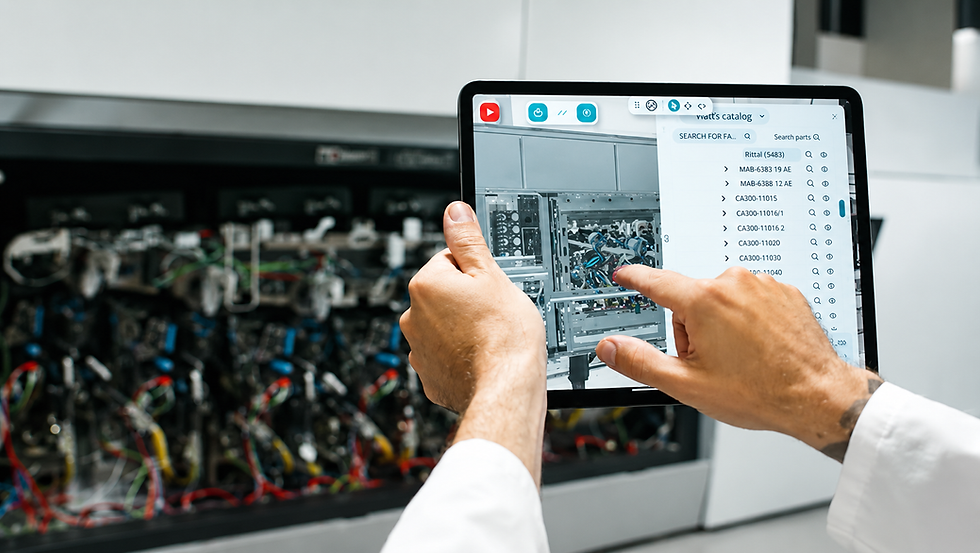
Platform-based solutions now remove most of the traditional engineering burden. A digital twin platform like frontline.io converts existing CAD files into a live, interactive digital twin in minutes - no custom development required - which teams then use for immersive training, guided maintenance flows, and remote support without interrupting production.
What is the difference between a digital twin and a simulation? A simulation is a standalone model run on assumed inputs. A digital twin is permanently connected to a real physical system, updates automatically with live data, and can actively control the physical entity. The key difference is the real-time, bidirectional data link (Aurich et al., 2025, p. 2–3).
What industries use digital twins the most? Automotive, aerospace, electronics, pharmaceuticals, and industrial equipment manufacturing are among the most active adopters. The machine level (individual equipment) has the highest concentration of real-world implementations at 43.6% of studied cases (Aurich et al., 2025, p. 15–16).
What is the most common use of a digital twin in manufacturing?
Monitoring and control is the dominant application, present in 88.6% of reviewed implementations. It is most commonly combined with prediction functions -
75% of prediction-enabled digital twins also incorporate real-time monitoring and control (Aurich et al., 2025, p. 14–15).
Can small manufacturers implement digital twins? Yes, but adoption among SMEs remains limited due to high upfront costs, insufficient in-house expertise, and the absence of structured development methodologies (Villegas et al., 2025, p. 1). Modular, platform-based solutions and cloud-hosted digital twin services are lowering the entry barrier. Platforms like Frontline.io are specifically designed to make digital twin deployment accessible to manufacturers without large in-house data science teams.
What is a sustainable digital twin? A sustainable digital twin (SDT) is designed to track and optimize environmental performance — energy consumption, waste generation, and carbon footprint — alongside traditional operational KPIs. Literature documents applications in emission reduction and raw material utilization optimization in production environments (Villegas et al., 2025, p. 11).
What is the difference between a digital twin and a digital shadow? A digital shadow receives data automatically from the physical entity but cannot send instructions back. A digital twin adds the reverse channel — it can actively influence the physical system based on its virtual model's outputs, enabling closed-loop control (Aurich et al., 2025, p. 2).
References
Aurich, Jan C., Jan Mertes, Marcel Wagner, Marius Schmitz, Matthias Klar, and Bahram Ravani. "Digital Twins in Manufacturing: A Taxonomy for Manufacturing Applications." Digital Twin 2, no. 1 (2025): 2496645.
Fuhrländer-Völker, Daniel, Martin Lindner, Magnus von Elling, Tim Frieß, Sebastian Karnapp, and Matthias Weigold. "Method for the Development and Application of Digital Twins in Manufacturing." Production Engineering 19 (2025): 959–973.
Sun, Li, Ziyiming Jiao, Shihao Wang, Feng Jiang, and Xianghui Li. "A Consistency Evaluation Method for Digital Twins in Manufacturing." IEEE Access 13 (2025): 109046–109056.
Villegas, Luis Felipe, Marco Macchi, and Adalberto Polenghi. "Digital Twins in Manufacturing: A Unified Conceptual Framework." Annual Reviews in Control 60 (2025): 101031.